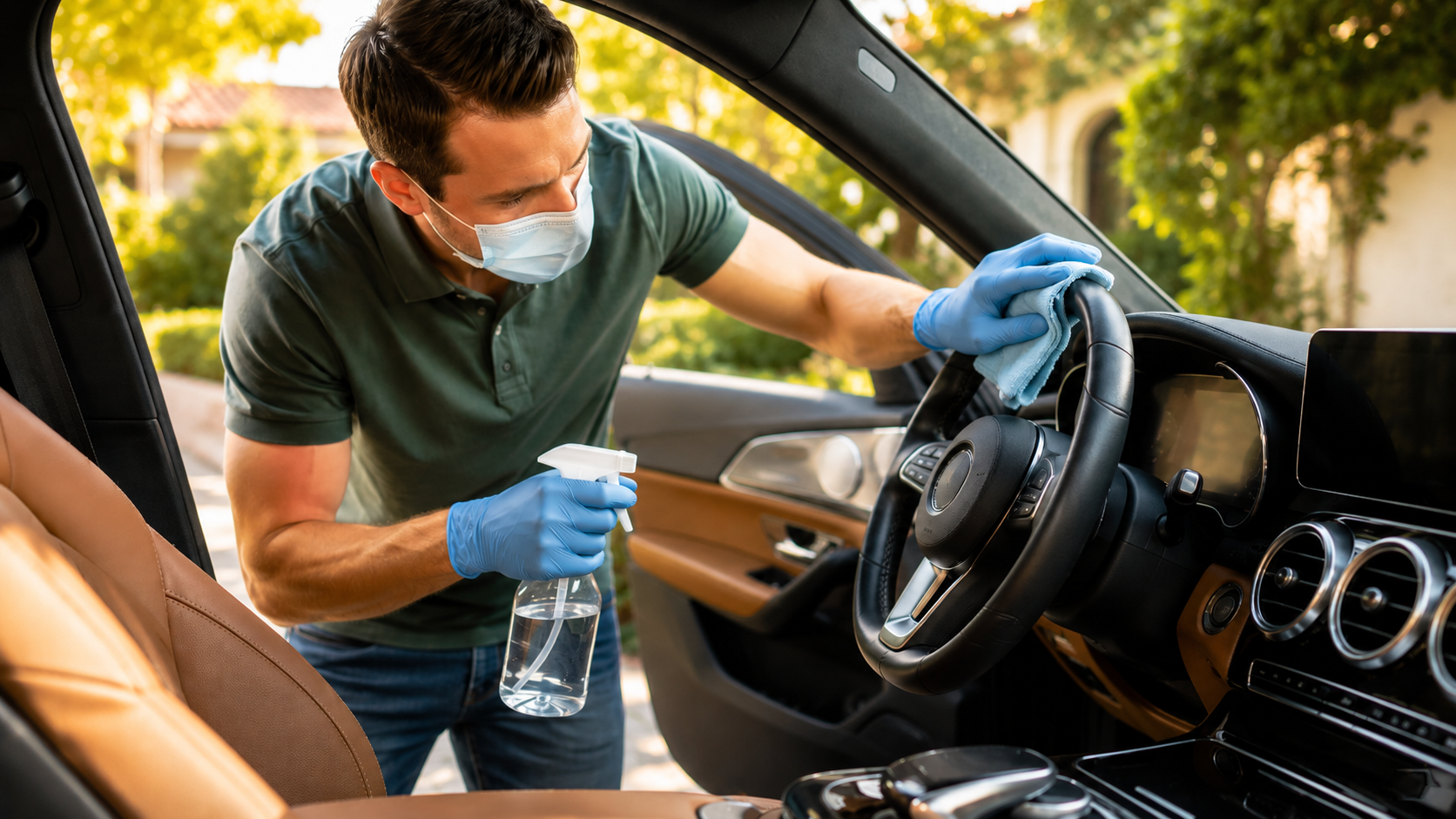

Part 1: Why Your Car Isn't Fragrance-Free
The Science
Even without a hanging air freshener, your car's cabin air is likely filled with chemical-based fragrance components and volatile organic compounds, also known as VOCs. Because car interiors are small, enclosed spaces, they act as concentrated traps for chemical exposure.
Heat Multiplies the Toxicity
A study in Environment International by Geiss et al. discovered that VOC concentrations inside private cars are 40 percent higher in the summer, when interior temperatures can soar up to 70 degrees Celsius, or 158 degrees Fahrenheit.
"Natural" Air Fresheners Are Not Safe
Dr. Anne Steinemann's research revealed that both "regular" and "natural" air fresheners emit hazardous chemicals. Across just 12 products, researchers detected 546 volatile chemical emissions, representing 275 unique VOCs, which are rarely disclosed to the public.
The Illusion of "Clean"
Research published in Chemosphere by Jo et al. confirms that commercial air fresheners do not actually clean the air, they add more VOCs to it. Rather than removing odors, air fresheners work by masking them, layering scent chemicals on top of existing smells while releasing their own volatile compounds into the enclosed cabin.
"Secondhand Scents" Are the New Secondhand Smoke
The parallel between tobacco smoke and chemical fragrance is striking. Both heavily degrade indoor air quality. Fragranced products and cigarette smoke share highly toxic chemical profiles, including:
- Acetone
- Formaldehyde
- Benzene
- Acetaldehyde
- Terpenoids
- Phenols
The Hidden Chemical Health Risks
Peer-reviewed studies reveal that the ingredients lurking in car fragrances carry serious health implications.
Endocrine Disruptors
Common examples: Phthalates, including DEP, DBP, DEHP, and BHT.
Specific health risks: These chemicals can disrupt hormone signaling. They have been studied in relation to erectile dysfunction through their effects on adult androgen and estrogen pathways, as reported in a national health survey analysis. They have also been linked to abnormal reproductive organ development in infants, according to Pastor-Nieto et al.
Air Pollution and Carcinogens
Common examples: Benzene, Toluene, and Acetaldehyde.
Specific health risks: Benzene and Toluene are toxic petroleum derivatives found in car air care products. Acetaldehyde is a known toxicant that can exacerbate allergic airway inflammation and asthma, according to Kawano et al.
Air-Reactive Sensitizers
Common examples: Limonene, Linalool, and Terpenes.
Specific health risks: These are found heavily in "natural" citrus or floral scents. Once exposed to the air, they oxidize and become aggressive skin and airway sensitizers. Terpenes can also react with ambient ozone to create secondary formaldehyde inside the car, according to Nazaroff and Weschler.
Part 2: The Grueling Reality of the "New Car Smell"
Many people assume that a few days of rolling the windows down will eliminate the "new car smell." In reality, this scent is actually latent chemical off-gassing from modern industrial adhesives, polyurethane foam padding, artificial leather, flame retardants, plastics, and sealants.
Why It Takes Months or Years to Clear
Massive Material Volume. You are not just dealing with a surface scent. You are dealing with chemicals embedded throughout the entire physical structure of the cabin.
Slow Polymer Decay. The plastics and adhesives are long chains of polymers that slowly break down over time, continuously releasing unreacted monomers like benzene and formaldehyde in a slow-motion chemical decay.
The Seasonal Re-Activation. You might think your car is finally clear in the spring, only for a hot summer day to hit. Extreme heat re-activates the interior materials, causing a brand-new wave of heavy chemical off-gassing. This seasonal rubber-band effect is why the process regularly drags on for 6 months to 2 years.
The Used Car Preference
Because the off-gassing process takes months or years of constant ventilation to drop to safer levels, many people in the chemical sensitivity, MCS, asthma, and mast cell activation communities explicitly prefer buying used cars, ideally 3 or more years old. Buying used allows a previous owner to absorb the brunt of that toxic window of peak off-gassing, providing the chemically sensitive person with a far safer, pre-ventilated baseline environment.
Part 3: How to Make Your Car Fragrance-Free

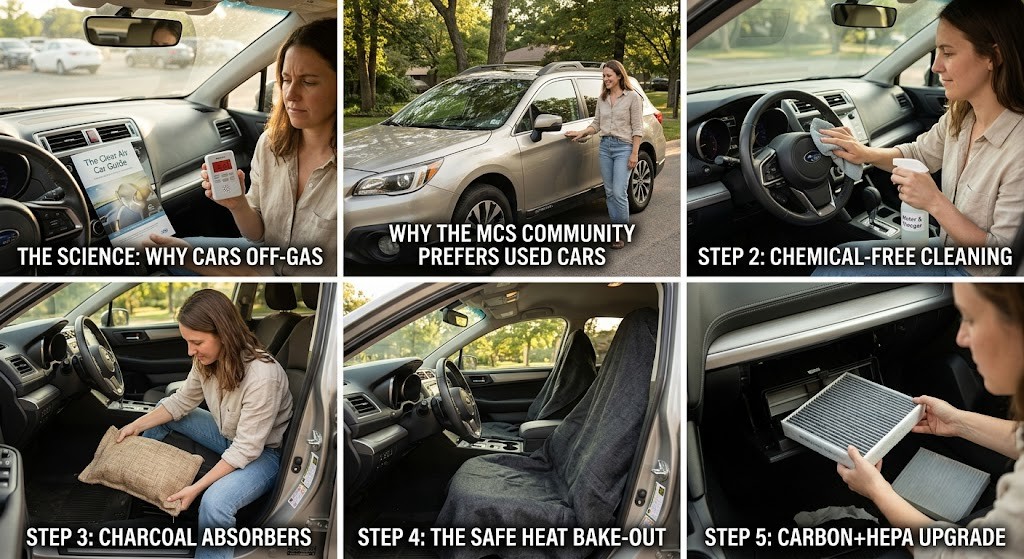
Step 1: Purge and Audit the Cabin
Remove all hanging trees, vent clips, and hidden scented items. Because fragrances are tracked in on clothes, also audit your personal care routine to avoid tracking in unwanted scents before driving.
Step 2: Decontaminate Hard Surfaces
Avoid commercial detailing sprays, which often contain hidden endocrine-disrupting chemicals like BHT. Wipe the dashboard, steering wheel, and vinyl panels using a microfiber cloth dampened with plain water or a 50/50 mix of distilled white vinegar and water.
Step 3: Deploy Carbon and Charcoal Absorbers
Do not spray masking agents. Place activated charcoal bags under the front seats. Carbon is highly porous and helps trap airborne VOCs and heavy fragrance fixatives like phthalates, reducing their concentration in the cabin air over time.
Step 4: Execute a Heat "Bake-Out" with Carbon Blankets
To safely accelerate the clearing of deep-set scents without chemicals or ozone, use a high-heat flush. Buy a bulk roll of activated carbon filter media sheet, which is industrial carbon blanket material, and drape it directly over the car seats. Roll up the windows and let the car sit in direct hot sun for several hours. The intense heat coaxes the fragrance out of the cushions, and the carbon blanket sitting directly on top helps trap the released VOCs. Afterward, open all doors to flush the cabin.
Step 5: Install an Upgraded Cabin Air Filter
Standard paper filters only trap dust. Replace your cabin filter with a HEPA filter that features an integrated activated carbon or charcoal layer to continuously scrub passing Benzene, Toluene, and exhaust fumes from the cabin air.
Part 4: Protecting Your Clean Air Sanctuary
Establish Passenger Boundaries
Advise passengers not to apply heavily scented personal products right before getting in. The Dermatology Online Journal warns that scented lotions can behave as aggressive skin irritants, and in some cases can trigger contact allergies and contact dermatitis on vulnerable skin.
Instruct Valets and Mechanics
When dropping your car off for service or a car wash, explicitly state: "No air fresheners, no sprays, and no scented interior cleaners." Place a temporary sticky note over the instrument cluster as a reminder.
Manage the Air Intake
If dealing with a newer car, avoid the AC "Recirculate" mode for the first few months to ensure stale chemical vapors are constantly being flushed out. If dealing with an older, cleared car, use "Recirculate" primarily when stuck in heavy traffic to prevent external exhaust fumes from overloading your cabin filter.
Recommended Sourcing
To ensure you are not accidentally tracking manufactured scents, perfumes, or hidden endocrine disruptors back into your vehicle through your clothes or skin, it is vital to audit your daily personal care items. For a trusted selection of verified personal care items, laundry detergents, and deodorants, you can shop at Fragrance Free Nation to completely clean up your routine.
Disclaimer: This guide is for informational purposes only and is not intended to diagnose, treat, or replace medical advice. Many of the associations described come from scientific research and, in some cases, reflect correlations rather than proven cause and effect. If you have specific concerns about chemical exposures, please consult your healthcare provider.
References
- Geiss O, Tirendi S, Barrero-Moreno J, Kotzias D. Investigation of volatile organic compounds and phthalates present in the cabin air of used private cars. Environment International. 2009;35(8):1188-1195. doi.org/10.1016/j.envint.2009.07.016
- Steinemann A, Nematollahi N, Weinberg JL, Flattery J, Goodman N, Kolev SD. Volatile chemical emissions from car air fresheners. Air Quality, Atmosphere & Health. 2020;13(11):1329-1334. doi.org/10.1007/s11869-020-00886-8
- Jo WK, Lee JH, Kim MK. Head-space, small-chamber and in-vehicle tests for volatile organic compounds emitted from air fresheners. Chemosphere. 2008;70(10):1827-1834. doi.org/10.1016/j.chemosphere.2007.08.021
- Nazaroff WW, Weschler CJ. Cleaning products and air fresheners: exposure to primary and secondary air pollutants. Atmospheric Environment. 2004;38(18):2841-2865. doi.org/10.1016/j.atmosenv.2004.02.040
- Lopez DS, Advani S, Tsilidis KK, et al. Association of urinary phthalate metabolites with erectile dysfunction in racial and ethnic groups in the National Health and Nutrition Examination Survey 2001-2004. American Journal of Men's Health. 2017;11(3):576-584. doi.org/10.1177/1557988316641370
- Pastor-Nieto MA, Gatica-Ortega ME. Ubiquity, hazardous effects, and risk assessment of fragrances in consumer products. Current Treatment Options in Allergy. 2021;8(1):21-41. doi.org/10.1007/s40521-020-00275-7
- Kawano T, Matsuse H, Fukahori S, et al. Acetaldehyde at a low concentration synergistically exacerbates allergic airway inflammation as an endocrine-disrupting chemical and as a volatile organic compound. Respiration. 2012;84(2):135-141. doi.org/10.1159/000337112
- Pona A, Gonzalez CD, Walkosz BJ, Dellavalle RP. Scented lotions may cause scarring and premature fading of tattoos. Dermatology Online Journal. 2020;26(10). escholarship.org/uc/item/5d2676s2